Life in Toronto never seems to slow down. For many women+, it feels like a sprint (or perhaps a never-ending marathon). Between career pressures, caring for others, and often unspoken expectations, it’s easy to feel as though we are running on empty. If you’re feeling stretched too thin, you’re not alone.
In fact, more than 2.5 million Canadians face barriers to accessing mental health care (Lowe et al., 2024). The impact on women+ is especially concerning. Over the past ten years, rates of anxiety and depression in young women+ in Canada have more than doubled (Statistics Canada, 2023).
But here’s the thing: feeling overwhelmed isn’t an indication of weakness. It means you’re human. Therapy is a space to step back, breathe, and recognize your inner strength.
It’s Okay to Experience These Moments of Overwhelm – It Will Pass
Stress looks different for everyone, but for women+, it’s often layered. Work, relationships, family life, and personal goals can create a constant undercurrent of pressure. Add in major life transitions like parenthood, possible losses, or hormonal fluctuations like menopause, and that pressure can build into something harder to manage.
Women+ report higher levels of anxiety and depression than men (CAMH, 2023). But mental health isn’t just about statistics—it’s about your experience. Therapy offers a confidential, non-judgmental space to explore your feelings and the contributing experiences or underlying causes.
Within that space, many women+ begin to reclaim their inner capacity, finding ways to understand, reflect, and flourish despite the circumstances.
Therapy Isn’t Just for Crisis
A common myth is that therapy is only for when things appear to be falling apart. The truth? Many people seek therapy not because they’re in crisis, but because they want to grow, heal, or gain clarity. The process can be affirming and supportive.
Therapists use a range of approaches, each aspiring to meet you where you are. Some of the most effective include:
Cognitive Behavioral Therapy (CBT): Helps you become aware of the thought patterns often contributing to your stress—and invites you to shift them to more constructive patterns.
Acceptance and Commitment Therapy (ACT): Encourages you to make space for difficult emotions while taking meaningful action aligned with your values.
Internal Family Systems (IFS): Guides you in exploring different parts of yourself with compassion, helping you reconnect and understand the roles while supporting your inner self to assume greater presence rather than judgment.
How Therapy Helps You Reclaim Inner Strength
Therapy isn’t a one-size-fits-all journey. It evolves with your needs and your unique experiences. But here are just a few ways it helps women+ move from feeling overwhelmed to grounded:
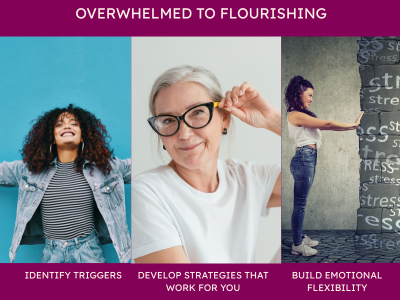
Identify Triggers: Understanding what elevates your stress—whether it’s a situation, thought, or experience—gives you back a sense of control. If you can notice it, you can take steps to understand better and manage it.
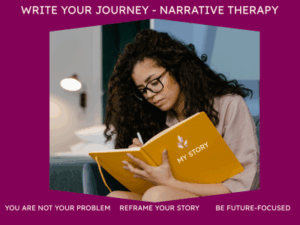
Develop Strategies That Work for You: From mindfulness to journaling, therapy can help you develop strategies that respond distinctly to the components of your life. One study found that mindfulness-based practices significantly reduce stress and boost well-being (Pascoe et al., 2020).
Build Emotional Flexibility: Strengthening your capacity doesn’t mean you’re unaffected—it means you are learning to integrate and adapt. And that adaptability is a core part of your growing inner strength.
Set Boundaries: Especially for women+ who often put others first, learning to nurture your energy is a vital skill. Therapy helps you to explore the potential to say “no” with confidence and commitment to self.
Reconnect with What Matters: Therapy can guide you toward living in alignment with your values, helping you feel more like your true and magnificent self, grounded in your inner strength.
More Women+ Are Seeking Therapy
In Toronto and across Ontario, more women+ are choosing therapy—and that’s a sign of courage and self-recognition. The stigma has been continuing to lift, and the benefits are more apparent than ever. A 2024 study found that empowerment-focused therapy had a measurable impact on women’s mental health and self-esteem (Bandara et al., 2024). Postpartum research supports this as well—women who receive regular emotional support report higher satisfaction and stronger bonds (Varin et al., 2020).
Therapy isn’t about “fixing” you. It’s about strengthening what’s already within you—your authentic potential, your voice, your inner strength.
You’re Not Alone—And You Don’t Have to Do It Alone
Starting therapy can feel like a big leap, especially when you might already be carrying so much. But it can be a step toward something powerful: a peaceful mind, self-determination, and a life that feels more your own.
At Magnificent Minded Studio, we offer compassionate, evidence-based therapy for women+ across Toronto and Ontario. Whether you’re navigating anxiety, burnout, trauma, or a major life transition, we’re here to help you rediscover your inner strength with kindness and care.
In case there has been any doubt… You are not broken. You are becoming.
What Has Helped You Develop Your Inner Strength During Challenging Moments?
We all have the capacity to tap into the magnificence that has brought us to the place we are today and find a way through times that seemed impossible to overcome. Take a moment to reflect on what has helped you along the way.
References
Bandara, N. A., Al-Anzi, S. M. F., Zhdanova, A., & Hirani, S. (2024). Women’s Empowerment and Mental Health: A Scoping Review. Women, 4(3), 277-289. https://doi.org/10.3390/women4030021
Lowe, L., Fearon, D., Adenwala, A., & Harris, D. W. (2024). The state of mental health in Canada 2024: Mapping the landscape of mental health, addictions and substance use health. Canadian Mental Health Association.
Pascoe, M. C., Thompson, D. R., Jenkins, Z. M., & Ski, C. F. (2017). Mindfulness mediates the physiological markers of stress: Systematic review and meta-analysis. Journal of Psychiatric Research, 95, 156–178. https://doi.org/10.1016/j.jpsychires.2017.08.004
Statistics Canada. (2023). Canada at a Glance, 2023 Health. Retrieved July 8, 2025, from https://www150.statcan.gc.ca/n1/pub/12-581-x/2023001/sec8-eng.htm
The Centre for Addiction and Mental Health (CAMH). (2023). Mental Illness and Addiction: Facts and Statistics. Retrieved July 8, 2025, from https://www.camh.ca/en/driving-change/the-crisis-is-real/mental-health-statisticsVarin, M., Palladino, E., Orpana, H. M., Wong, S. L., Gheorghe, M., Lary, T., & Baker, M. M. (2020). Prevalence of Positive Mental Health and Associated Factors Among Postpartum Women in Canada: Findings from a National Cross-Sectional Survey. Maternal and Child Health Journal, 24(6), 759–767. https://doi.org/10.1007/s10995-020-02920-8