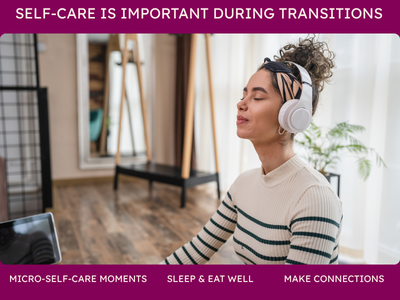
Life transitions—whether you’re starting a new job, becoming a parent, moving to Toronto, or navigating the end of a relationship can feel overwhelming. In these moments of change, self-care often falls to the bottom of your list. But taking care of yourself isn’t indulgent—it’s essential for staying grounded, cultivating inner strengths, and moving forward with clarity.
At Magnificent Minded Studio, we believe every woman+ deserves the same compassionate support often extended to others. This simple, practical guide will help you nurture your emotional well-being as you navigate life’s changes.
Why Self-Care Matters When Life Shifts
Significant transitions can disrupt your sense of self, reshape aspects of your routines, impact relationships, and contribute to a range of emotions—such as fear, sadness, excitement, or anxiety. Studies show that depression and anxiety are especially common in women during transitional periods like menopause or postpartum (Soares, 2023).
For women+ going through a life transition, practicing regular self-care can help regulate your emotions, stabilize your mood, and reconnect you with your inner strength which will be invaluable at this time.
1. Embrace Micro-Self-Care Moments
When life feels uncertain or unpredictable, even the smallest self-care practices can make a significant difference. Try:
- Box Breathing: Inhale, hold, exhale, and hold for four counts each.
- Mindful Sips: Pay attention to the warmth and taste of your tea or water.
- Gratitude Moment: Take time to name and visualize two to three things you’re grateful for.
These bite-sized moments help remind women+ during a transition period that it is possible to manage this time with care and intentional self-compassion. Research confirms that mindfulness practices are effective in reducing stress and anxiety during transitional periods, such as pregnancy (Pan et al., 2023). Even our happiest moments are transitions that can have unforeseen effects.
2. Prioritize Restful Sleep & Nourishment
Emotional shifts can be exhausting—rest and nutrition can be foundational life lines that replenish what is being exerted. Establish a gentle bedtime routine: dim the lights, avoid screens, savour a calming cup of tea, and release the events of the day. Focus on small nutritional changes: more leafy greens, reduce processed food, and drink plenty of water. Balanced nutrition has been found to maintain balanced mood states, particularly for women in transition during menopause (Grigolon et al., 2023).
When your body is nourished, your mind benefits as well.
3. Practice Gentle Movement
Movement isn’t just for fitness-seekers—it’s self-care. A 10-minute walk, light stretching, or gentle yoga can ease tension, boost energy, and improve mood. Physical activity has been shown to significantly reduce depression and anxiety symptoms in women, especially during major life transitions (Singh et al., 2023).
4. Reflect Through Journaling
Journaling can help you process emotions and reflect on your experiences. Try spending 5–10 minutes writing freely, or use prompts like:
- What went well today?
- What am I feeling right now?
- How am I feeling about this current period of transition?
- What could help me feel supported and at peace?
Writing provides a safe space for your thoughts, helping you build emotional awareness, insight, and clarity over time.
5. Build Your Support Network
Social support matters. Whether it’s coffee with a friend, joining a group with like-minded people, or a phone call with someone who understands, connection can help you feel a sense of belonging and supported. If you’re feeling as though you are on your own during a period of transition, consider a support network to create beneficial connection opportunities.
Seeking Professional Support
Some transitions evoke deeper emotions that are difficult to navigate alone. Therapy can provide a non-judgmental space to help you explore experiences and circumstances with clinical approaches that address your needs. Compassion-based therapy, for instance, has been shown to improve mental health outcomes for women post-divorce by enhancing self-compassion and emotional regulation (Saberi et al., 2024).
At Magnificent Minded Studio, we offer therapy tailored to women+ in transition, meeting you where you are with empathy, understanding, and holistic, evidence-based care.
Ready to Begin?
What’s one small self-care practice you can start today? Whether it’s a deep breath, a short walk, or a moment of gratitude, know this: your journey deserves affirmation, compassion, and support.
If you think we can help, connect with Magnificent Minded Studio in Toronto. Let’s help you establish a pathway forward—and discover your most magnificent self.
References
Grigolon, R. B., Ceolin, G., Deng, Y., Bambokian, A., Koning, E., Fabe, J., Lima, M., Gerchman, F., Soares, C. N., Brietzke, E., & Gomes, F. A. (2023). Effects of nutritional interventions on the severity of depressive and anxiety symptoms of women in the menopausal transition and menopause: A systematic review, meta-analysis, and meta-regression. Menopause, 30(1), 95–107. https://doi.org/10.1097/GME.0000000000002098
Pan, W. L., Lin, L. C., Kuo, L. Y., Chiu, M. J., & Ling, P. Y. (2023). Effects of a prenatal mindfulness program on longitudinal changes in stress, anxiety, depression, and mother–infant bonding of women with a tendency to perinatal mood and anxiety disorder: A randomized controlled trial. BMC Pregnancy and Childbirth, 23, 547. https://doi.org/10.1186/s12884-023-05955-1
Saberi, F., Ali Mahdi, M., & Kazemi, A. S. (2024). The effect of compassion-based therapy on women’s mental health after divorce. International Journal of New Findings in Health and Educational Sciences (IJHES), 2(3), 78–90. https://doi.org/10.63053/ijhes.90
Singh, B., Olds, T., Curtis, R., Dumuid, D., Virgara, R., Watson, A., Szeto, K., O’Connor, E., Ferguson, T., Eglitis, E., Miatke, A., Simpson, C. E. M., & Maher, C. (2023). Effectiveness of physical activity interventions for improving depression, anxiety and distress: An overview of systematic reviews. British Journal of Sports Medicine, 57(18), 1203–1209. https://doi.org/10.1136/bjsports-2022-106195
Soares, C. N. (2023). Anxiety and depression in midlife transition and beyond: The role of estrogens. Current Opinion in Endocrine and Metabolic Research, 31, 100457. https://doi.org/10.1016/j.coemr.2023.100457